
Since its founding, Belhaven University has sought to fulfill the mission expressed in its motto: "To serve, not to be served."
 Founded in 1883 through the merger of Mississippi Synodical College and McComb Female Institute, the University we know today put roots down in Jackson in 1894 with Dr. Lewis Fitzhugh as president. A small school for a few dozen women, Belhaven College for Young Ladies opened in the former mansion of business leader and state senator, Jones S. Hamilton, located on Boyd Street. The College took the name of the house, Belhaven, in honor of Hamilton's ancestral home in Scotland.
 Fire destroyed the original building in February 1895, but, with the help of Jackson citizens, the College reopened in the fall of 1896 on the same site. Dr. Fitzhugh served as president until his death in 1904, after which his heirs sold the College to Dr. J. R. Preston. He served as president until the College was destroyed again by fire in 1910, at which time Dr. Preston donated the title of the College to the Presbyterian Church. First Presbyterian Church in Jackson advocated on Belhaven’s behalf with the Synod for establishing the school in an undeveloped section of Jackson—an area which is now the campus home on Peachtree Street and around which Belhaven neighborhood grew up.
 In September 1911, the Central Mississippi Presbytery reopened the school as Belhaven Collegiate and Industrial Institute after the construction of a massive, new three-story brick building that would eventually become Preston and Fitzhugh Halls. Dr. R. V. Lancaster of McComb Female Institute became the third president when the two institutions merged. In 1912, Belhaven became the first women’s college to teach chemistry. In 1915, the Board of Trustees changed the school's name to Belhaven College. During these years, improved curricula guidelines and student services were established. Dr. W. H. Frazier succeeded Lancaster as president from 1918-21, and, during his tenure, enrollment grew to 230 students.
 In 1921, Guy T. Gillespie, a Presbyterian minister pastoring in Lexington, Mississippi, began a presidency that would last thirty-three years. During Gillespie's tenure, Belhaven earned its first accreditation, started an endowment fund, and made scholarship aid available. Through depression, war, and unstable economic times, Belhaven maintained its Christian mission in the midst of overwhelming challenges. In 1927, Belhaven introduced a Bachelor of Music degree and quickly gained a reputation as an elite school for those drawn to a career in the arts. The Belhaven Singing Christmas Tree began in 1933 and is today the world’s oldest outdoor singing Christmas Tree tradition. As for other artistic distinctions, Belhaven faculty founded both the Jackson Symphony Orchestra and the Mississippi Opera Guild during the 1940s.
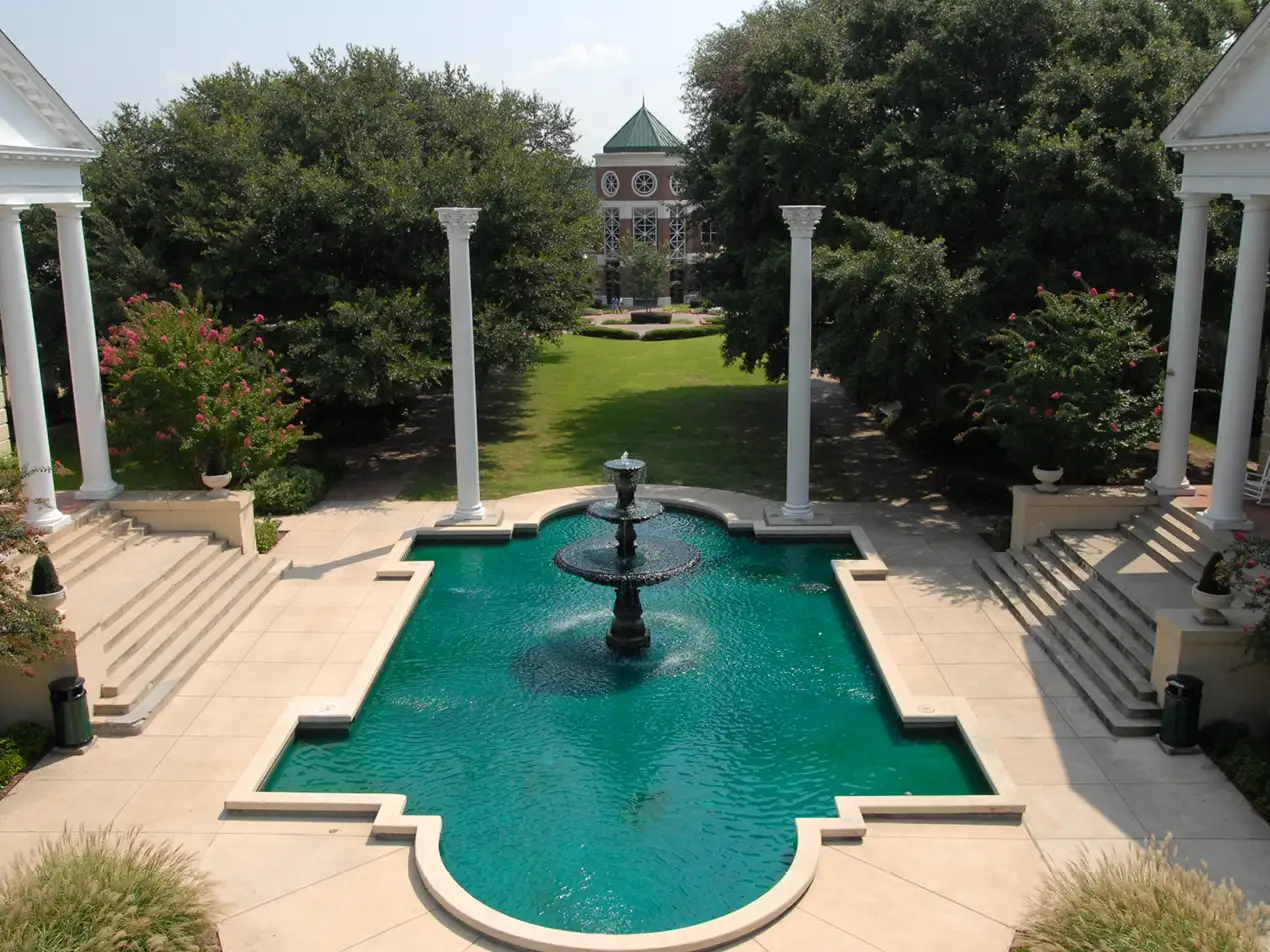
One of the most important moments in Belhaven’s history was a major fire on August 9, 1927—the third devastating fire in the school’s history. That day, Dr. Gillespie was on a train from New York to Princeton when he received the following telegram from his secretary, Jennie Armistead, at 7:35 in the morning: “Belhaven on fire. Absolutely no chance of saving.” Lightning had struck the center of the college’s only building. When the fire was finally extinguished, only the stately columns remained from the center section. Today, two memorial columns are kept in the center of campus in remembrance of those who had the courage to rebuild and carry forward through the Great Depression.
The fire triggered a time of rebuilding for Belhaven. The devastated main building was separated into two mirror buildings—Preston and Fitzhugh Halls—and a fountain was added between them. Also, the first indoor swimming pool in Mississippi was constructed on the ground floor of Fitzhugh Hall. A new residence hall, Helen White, was built in 1930, and Lancaster Hall Student Center (started in 1927) was completed in 1938. Raymond Hall was built in 1940, and a new recreation building, Girault Hall, was completed in 1949.
Dr. Gillespie’s greatest contribution is measured by his twenty-five year effort to gain accreditation from the Southern Association of Colleges and Secondary Schools. After years of strengthening academic programs and faculty credentials, building financial stability, creating a library of academic stature, and meeting a host of other standards demanded by the accreditors, unconditional accreditation was granted to Belhaven College on March 28, 1946.
 Dr. McFerran Crowe, the pastor of North Avenue Church in Atlanta, succeeded Gillespie in 1954 and, for six years, expanded and upgraded the faculty while modernizing business operations. That same year, the Board of Trustees voted to make Belhaven fully coeducational, leading to the first six male enrollments for the 1954 academic year. The curriculum was expanded to include the liberal arts and sciences. Dr. Crowe helped the college articulate and implement its commitment to teaching from a Reformed perspective while including faculty from a variety of evangelical denominations. He also prioritized construction of new buildings and launched aggressive fundraising efforts that would see fruit following his time of service. Intercollegiate sports for men were added, for example, men’s basketball (1956) and tennis (1956). Dr. Robert Cooper served a short time as interim president following service as vice president with Dr. Crowe’s administration. Afterwards, Dr. Cooper continued many years as a Greek professor with the College.
 Dr. Howard J. Cleland was principal of Murrah High School in Jackson when he was elected president of Belhaven in 1961. An ambitious expansion program marked his tenure, with seven major new buildings completed: Wells Hall (1962), Heidelberg Gymnasium (1963), Irby Science Hall (1963), Robertson Hall (1966), Caldwell Hall (1967), Warren Hood Library (1974), and Bailey Dining Commons (1976). In 1971, the first African American students enrolled at Belhaven. In 1972, the Synod of Mississippi transferred ownership of the College to the Board of Trustees. Men’s baseball (1964) was added as an intercollegiate sport, as was women’s basketball (1972). The College’s enrollment and budget tripled during Dr. Cleland's seventeen-year tenure.
 In 1978, Dr. Verne R. Kennedy—a communications faculty member with prior service at the University of Georgia, University of South Alabama, and Louisiana College—was the first Belhaven alumnus elected to serve as chief executive of his alma mater. In eight years as president, he reaffirmed the College’s commitment to Christian service, renewed a covenant relationship with the Presbyterian Church USA, and strengthened ties with the Presbyterian Church in America and the Evangelical Presbyterian Church. He gained Board approval and support to develop Belhaven's Christian World and Life View, a cornerstone of the University today. During Dr. Kennedy’s tenure, Belhaven joined the Council for Christian Colleges and Universities and the Association of Presbyterian Colleges and Universities. Using his communications expertise, Dr. Kennedy implemented an effective and efficient administrative structure. A men’s soccer program was added in 1979, which led eventually to two NAIA National Championship titles (1992 and 2012).
 Another alumnus, Dr. Newton Wilson, became president in 1986 after many years of service as a faculty member and academic dean. During his nine-year term, enrollment nearly doubled to 1,000 students, and the number of Belhaven faculty holding terminal degrees surpassed 80%. The College also extended its outreach in nontraditional venues, establishing academic programs designed specifically for adult and evening students in 1988. Most importantly—in a direction-changing decision for Belhaven—the president, provost, and Board leaders addressed the institution’s long-term, slow “mission drift” and committed to (1) returning to evangelical faith as the centering hallmark of the school, (2) raising academic standards for applicants and academic quality of educational programs, and (3) becoming an advocate for racial reconciliation in Mississippi. As a result, Belhaven’s mission statement was redefined: “Belhaven University prepares students academically and spiritually to serve Christ Jesus in their careers, in human relationships, and in the world of ideas.”
 Dr. Roger Parrott was elected tenth president of Belhaven in the fall of 1995, after having served as a president and vice president of other Christian colleges. An aggressive effort was launched to begin a pattern of enrollment and program growth, coupled with a commitment to spiritual vitality and expanded service. During Dr. Parrott’s tenure, overall enrollment has increased from 1,000 to 5,000 students as the awareness of Belhaven grew beyond its long-term, Mississippi-based constituency.
The physical campus also has been transformed with the addition of major buildings and comprehensive renovations, including the following: Stuart C. and Stuart M. Irby Hall Classroom Wings (1998), Lakeview Women’s Residence Hall (1998), Heidelberg Gymnasium addition (1999), McCravey-Triplett Student Center (2002), Bettye Quinn House (2002), Center for the Arts (2003), Raymond Hall renovation (2004), Bitsy Irby Visual Arts and Dance Center (2005), Wells/Robertson Lobby (2007), Entergy Pavilion (2008), Fitzhugh Science Hall (2013), Newt and Becky Wilson Hall (2014), Dudley and Robbie Hughes University Village (2015), Dr. Billy Kim International Center (2016), and Belhaven Bowl Stadium and Track (2016).
Since 1995, the number of full-time faculty has quadrupled, undergraduate academic majors have expanded dramatically, and a new general core Worldview Curriculum has been established. The first master’s degree (Master of Business Administration) was begun in 1996, and an array of master’s degrees followed. In 2017, doctoral-level education began. The Legacy of Learning was established in 2006 to honor faculty serving Belhaven over twenty years.
Dance and theatre were added as majors in the late 1990s, eventually leading to national distinction for Belhaven as one of only 39 schools earning national accreditation in all four of the primary arts—theatre, music, visual art, and dance. Additional arts majors were added as well, including Creative Writing, Graphic Design, Arts Administration, and Film Production. The MFA in Dance began in 2013.
Dramatic expansion of academic programs was led by long-term senior vice-president and provost, Dr. Dan Fredericks, who also served as interim president in 1995 and as chair of the Biblical Studies Department before moving into administration.
In 2010, Belhaven College changed its name to Belhaven University in order to better represent the institution’s expanded breadth of programs and reach.
The University also established new intercollegiate sports during this period: football (1996), softball (1996), volleyball (1996), golf (1996), and men’s and women’s track and field (2013), as well as supporting programs such as marching band (2008). In 2014, Belhaven moved its athletic affiliation from the NAIA to the NCAA and joined the Division III American Southwest Conference.
The Memphis campus was opened (1996) and then expanded to two locations (2013). Additional branch campuses were added in Houston (2005), Orlando (opened 1999 and redesigned to online 2015), Chattanooga (2010), Atlanta (2011), Jackson LeFleur Campus (2011), and Madison, MS (2017). An online campus was launched in 2006 and has grown to offer a wide variety of undergraduate and graduate degrees.
Meaningful international partnerships have been created for both students and faculty; as a result, Belhaven attracts students from twenty-four nations. The University enjoys a special relationship with South Korea, and memorialized this friendship with construction of the Dr. Billy Kim International Center, named after Korea’s premier Church Statesman.
In the new century, Belhaven has received many national ranking accolades, including being named a U.S. News & World Report Top Regional University in the South, a U.S. News Best Online Education Program, and a U.S. News Best Value College. The Chronicle of Higher Education also honored Belhaven University as a “Great College to Work For.”
Verse of the Year
"Not by might nor by power, but by my Spirit," says the Lord Almighty.
Zechariah 4:6