Visual Arts Department Course Offerings

Areas of Study in Visual Arts:

Drawing

Drawing is the fundamental language of all the visual arts.

We believe that through a process of profound experiential drawing, emphasizing both accurate draftsmanship and deep sensitivity, a proper base can be established on which to build other skills. Freedom to express with confidence and power can only be attained in direct proportion to disciplined control.

For the untrained, this process begins with learning to see:  not merely to look, but to see with understanding, to see with more than the eyes. For the student already on this journey, it is a process of deepening and fine-tuning skills, increasing sensitivity and responsiveness, and experiencing drawing as another way of knowing about life and oneself.

Introductory classes focus on fundamental perceptual development and problem solving. Through time-proven exercises and repeated drilling, the student is taught to see. The act of correct observation is instilled as prerequisite to further development. Subject matter consists of assorted objects, plaster casts, and the live model. Gesture is established as the essential life force from which all other interpretation and expression emanates.

The process of learning to draw is demanding and time-consuming, and there are no short cuts.  However, the rewards are enriching and life-changing. Any student who has the determination, patience and commitment can attain a high level of skill in drawing. At Belhaven we are committed to assisting serious students in this vital area of growth.

Painting

Much like our approach to drawing, instruction in painting begins with an emphasis on careful observation of form, color, and light.  The fundamentals of oil technique are introduced with exercises that gradually increase in range and complexity.  Skills in observational painting provide a foundation from which students can also explore more expressive and conceptual approaches.

Sculpture

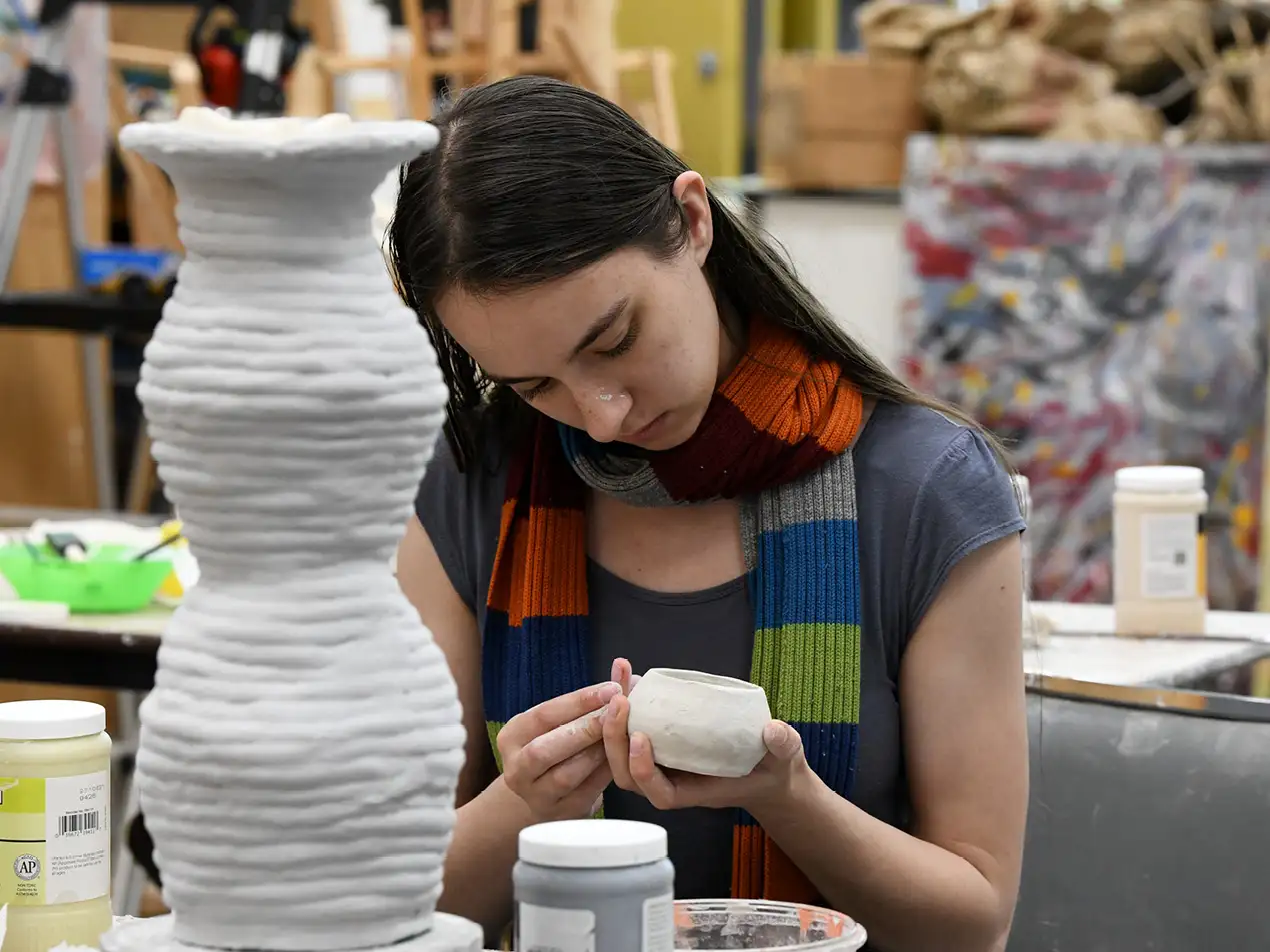
Perhaps more than any other mode of art-making, sculpture requires facility, dexterity, and overall familiarity with materials on the part of the artist. The knowledge of the attributes and limitations of sculptural substances is the key to unlocking their aesthetic potential. The basic sculpture courses provide an introduction for those with little or no experience with sculpture. The concepts, ideas, forms, and critical response to sculpture are all examined, but the main focus is on mechanical and technical issues associated with the primary materials and methods of working in the third dimension, typically wood, clay, and metals.

Advanced sculpture is a continuation of the basic sculpture courses.  The concepts, ideas, forms, critical response, materials and methods of sculpture continue to be examined; however, these courses allow students a freer, more personal exploration of the language of sculpture. A high level of maturity and responsibility is required.

Photography

The study of photography begins with an intensive technical examination of the camera and the various materials used in the production of a fine art photograph. In the semesters that follow, students develop a comprehensive understanding of the techniques and history of photography, exploring both purist and pictorialist approaches to photographic expression.  Upper-level courses also interface photography with graphic arts, design, and alternative non-silver printing processes.

Graphic Design

Computer graphics courses introduce students to current software applications and develop technical proficiency.  Graphic design courses build on these skills with projects involving the integration of creative problem-solving, conceptual thinking, and design usage.

Art History/Theory

A four-semester survey of art history from the ancient world to the present introduces students to major artistic monuments, styles, and cultures from both western and non-western civilizations.  Art history courses seek to develop visual literacy, skills in oral and written analysis of works of art, and Christian discernment in the interpretation of artifacts as they embody worldviews. 

Courses on aesthetics as well as modern and contemporary art theory explore the philosophical underpinnings of discourse on art from antiquity to the present.  Through the study of original texts by philosophers, artists, and critics, students investigate the basic premises, ideologies, and philosophies that have shaped pre-modern, modern, and postmodern artistic production and analyze them in light of a Christian worldview.

Art history and theory courses are open to students from all departments.

Course descriptions for the Visual Arts Department:

120-121 Drawing I-II (3-3).
ART 120: Introduction to drawing from observation, emphasizing accurate transcription of subject matter with regard to linear placement and value. (Fall only)
ART 121: Prereq: ART 120 or permission. Continued development of skills introduced in ART 120. (Spring only)
125   Perspectives on Creativity and Art (3).
Introduces visual arts students to broader questions of the artistic calling within a Christian worldview, the nature of the artistic process, the fundamentals of design and the visual elements, and the critique process.  (Fall only)
130-131 Design I-II (3-3).
ART 130: Foundational introduction to theories and terminology of design and their practical application. Unit projects focus on the elements of design and principles of organization in two dimensions and in black and white.  (Spring only)
ART 131 Prereq: ART 130 or permission. Expands on the foundational approach of ART 130 with a directed emphasis on color theory and three-dimensional design.   (Fall only)
215  Art Appreciation (3).
Introduction to artistic media, design concepts, and techniques as well as a historical overview of major artists, works, periods, and movements. Intended to enhance students’ understanding and enjoyment of art in everyday experience and provide the tools for critical analysis of historical and contemporary works of art in their cultural and philosophical contexts. Non-major credit only.  (Spring only)
220-221 Studio Drawing I-II (3-3). Prereq: ART 120-121.
An advanced drawing course building on skills learned in ART 120-121. Includes study of the skeletal and muscle systems of the human form, with practice drawing from the live model.  (Fall and spring)
230-231 Printmaking I-II (3-3)
An introduction to black and white relief and intaglio processes. The course is primarily intended to familiarize students with the tools and methods of relief and intaglio printing, with the goal of producing a successful edition.
240-241  Photography I-II (3-3). (Formerly ART 140-141.)
ART 240: Introduction to camera use as well as developing, enlarging, and printing black and white photographs. Emphasis is placed on the role of design and concept in fine art photography.
ART 241: Prereq: ART 240. Students begin to define their individual conceptual and technical style through the development of a black and white portfolio.  (Fall and spring)
250-251 Studio Painting I-II (3-3). Prereq: ART 120-121.
Introduction to the materials and processes of painting, with particular focus on the observation of light and color.  (Fall and spring)
280-281 Sculpture I-II (3-3). Prereq: ART 120-121, 130-131.
Introduction to mechanical and technical issues associated with the primary materials and methods of working in the third dimension. Students also develop a conceptual and historical perspective on both additive and subtractive sculptural processes.  (280, fall only; 281, spring only)
301-302  Independent Study and Research (3-3). Prereq: Junior standing.
An opportunity for students to pursue special artistic projects and research under faculty supervision. Subject to approval by faculty and chair.
320-321  Studio Drawing III-IV (3-3). Prereq: ART 220-221.
Continuation of ART 220-221. Drawing skills are developed and refined through continued work from the live model. Emphasis is also placed on the development of conceptual and interpretive skills.  (Fall and spring)
340-341  Photography III-IV (3-3). Prereq: ART 240-241.
350-351 Studio Painting III-IV (3-3). Prereq: ART 250-251.
Continued study of painting from life, with emphasis on observation of color and light. Increased attention is also given to personal interpretation and expression.  (Fall and spring)
360  World Art (3).
A survey of the art of selected peoples and cultures from Africa, Asia, and the Americas. Endeavors to identify universals of visual expression while also bringing Christian discernment to a reading of distinctive styles and methods as they embody worldviews. (Honors)  (Fall, even years)
361  Western Art I (3).
A study of the history of western art from the Ancient Near East through the Gothic period. Introduces students to the touchstones of the western artistic tradition, viewed in the context of Christian critical analysis. (Honors)  (Spring, odd years)
365  History of Photography (3).
A historical investigation of photography as an expressive art form.  This study traces technological advances in the photographic medium as well as the visual influences of 19th and 20th-century movements in art; critical readings in the aesthetics of photography contrast this new modern visual language with traditional artistic media in an effort to understand its unique character from a Christian perspective.  (Honors)  (Spring only)
380-381 Sculpture III-IV (3-3) Prereq: ART 280-281.
Further refinement of skills learned during the first two semesters as well as introduction to less traditional forms and methods of sculpture. Emphasis is placed on the integration of technique and design within the context of an emerging individual style and approach.  (380, fall only; 381, spring only)
399 Internship (3). Prereq: Junior standing and department chair approval.
Supervised practical experience in an art-related profession. Maximum internship credit is six hours, nine hours for graphic design. Refer to “Student Intern Programs and Practicums” for further requirements.
401 Senior Seminar I (3).  Prereq: Senior standing
Seminar course intended to prepare senior visual arts majors to enter the professional world of fine art and related fields.  Includes introduction to professional presentation, resume/portfolio preparation, public relations, business practices, and gallery work, culminating in preparations for the senior exhibition. (Fall only)
402  Senior Seminar II (3).  Prereq: Senior standing and faculty approval.
An opportunity for seniors to pursue special artistic projects and research in preparation for senior exhibition, under faculty supervision.  (Fall and spring)
420-421 Studio Drawing V-VI (3-3). Prereq: ART 320-321.
Continued refinement of conceptual, observational, technical, and interpretive skills in the development of a coherent body of work. (Fall and spring)
433 Portfolio Preparation (3). Prereq: ART 370.
Prepares students to enter the work force. Individual attention is provided to refine portfolios and make them more competitive, along with creating and producing a resume and self-promotion piece.
440-441  Photography V-VI (3-3). Prereq: ART 340-341.
ART 440: Lighting techniques as applied to environmental and studio portrait photography.
ART 441: Emphasis on photography as a collateral medium to language and graphic design in the communication of a marketing message. Explores lighting and product photography in a commercial context.  (Fall and spring)
450-451 Studio Painting V-VI (3-3). Prereq: ART 350-351.
Emphasis on experimentation and innovation in painting.  (Fall and spring)
460 Western Art II (3).
A survey of developments in European art from the Renaissance through c. 1850. In addition to formal and technical considerations, emphasis is placed on understanding and evaluating intent and meaning in light of the Christian worldview. (Honors)  (Fall, odd years)
461  Western Art III (3).
A survey of the last 150 years in the art of Europe and America. Introduction to modernity and postmodernity viewed from a Christian perspective, in an effort to understand the artistic context of our times. (Honors)  (Spring, even years)
462   Modern and Contemporary Art Theory (3). Prereq: ART 460 or 461.
A survey of texts and other statements by artists, art critics, and philosophers from c.1860 to the present. Examination from a Christian perspective of major theories informing visual art practices in the modern and postmodern world prepares visual arts majors to enter knowledgeably and redemptively into contemporary artistic discourse. (Honors)  (Spring only)
480-481  Sculpture V-VI (3-3) Prereq: ART 380-381.
Focus on refinement of skills, successful use of design principles, and research into contemporary modes of sculptural expression. Emphasis is placed on individual exploration and personal voice as well as the creation of a cohesive body of work.
498-499  Internship (3-3). Prereq: Junior standing and department chair approval.
Supervised practical experience in an art-related profession. Maximum internship credit is six hours, nine hours for graphic design. Refer to “Student Intern Programs and Practicums” for further requirements.

Return to Top

Site Map |
Search
FUTURE STUDENTS
Belhaven University